All sheets


Robot End Effectors: A Practical Reference
The end effector is the part of the robot that actually touches the work, and you pick it backwards: start from the object and the task, not from the robot. This guide covers 16 effector types across six classes: grippers, suction, soft and dexterous hands, and the process tools that do the real work of industry.
Mechanical grippers
jaws and fingers for known, rigid parts3 effector types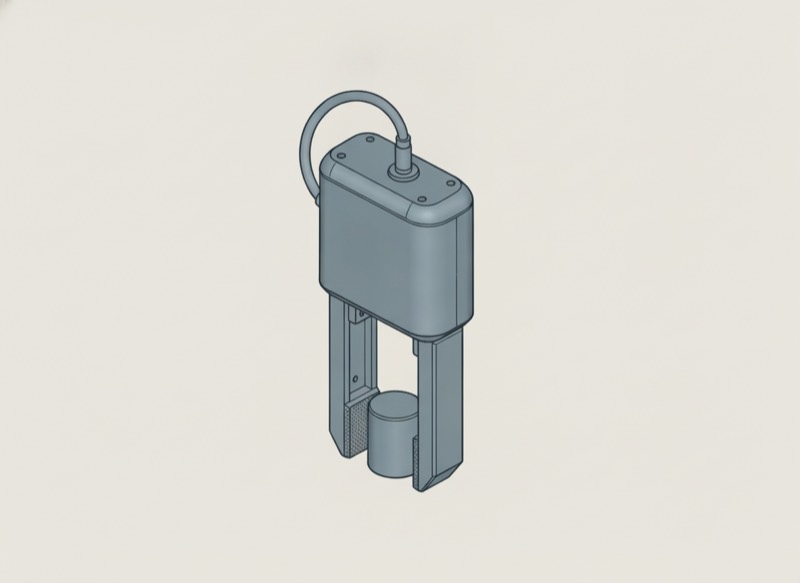
This is the default robot hand. Two fingers translate in parallel, driven by a servo through a screw or a rack, with programmable stroke, speed, and grip force. Electric actuation adds things a plain two-jaw gripper can't do: force control in software, part detection from motor current, and position feedback that tells you which object was grasped. With task-specific fingertips bolted on, it handles the overwhelming majority of industrial handling that doesn't go to suction.
Strengths & weaknessesProgrammable force and stroke cover a whole part family without retooling. Self-locking screws hold the part through a power loss. There is no air line, which matters in labs and electronics, and current-based grip detection gives you process feedback for free. On the weak side, two rigid contact lines need reasonable object geometry and pose accuracy, so wide flat objects and soft produce are a poor fit. Speed trails pneumatics, and per-unit cost runs 5–20× the pneumatic equivalent it often replaces.
When to useMake it your first candidate for discrete rigid parts when part families vary, when grip force has to be controlled, or when the cell can't use compressed air (labs, electronics, cobot cells, machine tending with SKU churn). Programmable stroke and force cover the variety without finger changeovers, and current-based grip detection comes free. If you're running high-cycle single-part duty, a pneumatic gripper costs a tenth as much, cycles faster, and outlasts it. For wide flat panels, limp goods, and soft produce, use suction or soft fingers instead.
Key numbersPayload 0.5–10 kg · grip force 20–500 N, set in software · stroke 5–150 mm · close time 0.2–1 s, slower than a pneumatic jaw · repeatability roughly ±0.02–0.05 mm · unit cost $500–5k.
ExamplesSchunk EGP/EGU lines, Robotiq 2F-85/140 (the cobot-era standard), OnRobot RG series, Zimmer electric ranges; Chinese entrants (DH Robotics, Hitbot) compressing prices; nearly every cobot demo ever filmed.
Economic profileThese are $500–5k products, and they sit at the heart of the cobot accessory boom. Distribution runs through plug-and-play ecosystem certification (UR+), which is the main moat. Chinese vendors have halved street prices in five years. The strategic position is default-choice status: integrators reach for a parallel-jaw gripper first and have to justify anything else, so a vendor's ecosystem position is worth more than its specs.
VideosGripper Sizing Assistant (SCHUNK) · Robot End Effectors: Uses, Benefits, and Costs (HowToRobot)
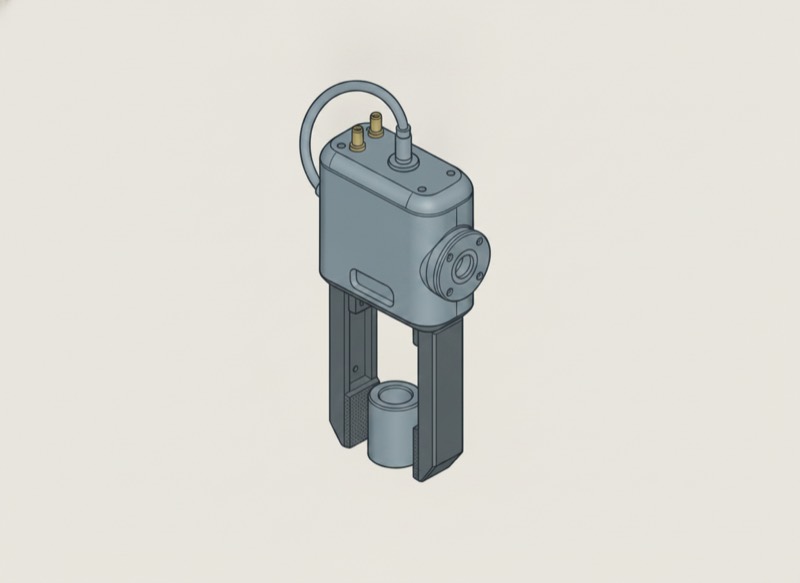
These do most of the industrial gripping and get very little attention. Compressed air drives two or three jaws through a wedge or piston mechanism. They are either open or closed with nothing in between, they actuate very fast, and they are close to perfectly reliable. Custom-machined fingers adapt the standard body to the specific part, which is the design philosophy in miniature: the gripper is a commodity, and the fingers are the engineering. Millions of them serve in machine-tending, molding, and assembly cells, cycling every few seconds for years.
Strengths & weaknessesThey're cheap, fast (tens of milliseconds), and immensely reliable, because the moving parts are just a piston and a wedge. Grip force per unit size is high, and dust and coolant don't bother them. The main weakness is binary operation: you get open or closed, with no force or position modulation unless you add hardware. They need plant air, which costs money and tethers the robot. One finger set covers one part family, so SKU diversity means changeovers. And you get no feedback beyond end-of-stroke switches unless you add sensors.
When to usePick pneumatic jaws for high-cycle, known-geometry handling when you already have plant air (machine tending, molding, and assembly cells gripping the same part family every few seconds for years), and put the engineering into custom fingers rather than into the gripper. At $100–800 with tens-of-millisecond actuation, nothing matches its cost per million cycles. If grip force has to modulate for delicate or variable parts, if SKU churn makes finger changeovers the bottleneck, or if you're in an air-free environment like a lab or electronics assembly, the electric parallel-jaw gripper is worth its 5–20× premium.
Key numbersPayload 0.1–20 kg · grip force 50–3,000 N at 6 bar across common sizes · actuation time 20–100 ms · repeatability around ±0.02 mm · rated life 10–30 million cycles on catalog units · unit cost $100–800.
ExamplesSchunk PGN-plus (the archetype, in its millions), SMC and Festo catalogs, three-jaw centric versions for round stock, sprue pickers on every injection-molding machine, CNC machine-tending cells worldwide.
Economic profileThis is a mature, profitable European/Japanese component oligopoly, with typical prices of $100–800 and margins coming from precision manufacturing and distribution. The shift to electric grippers takes bites out of the edges (controllability, air costs), but for high-cycle single-part duty nothing beats its cost-per-million-cycles. For diligence, treat it as the boring benchmark: a clever gripper startup has to beat it on uptime, and beating it on features isn't enough.
VideosGet a Handle on Gripper Technology (Festo) · Pneumatic Gripper Working Principles and Selection (Tameson)
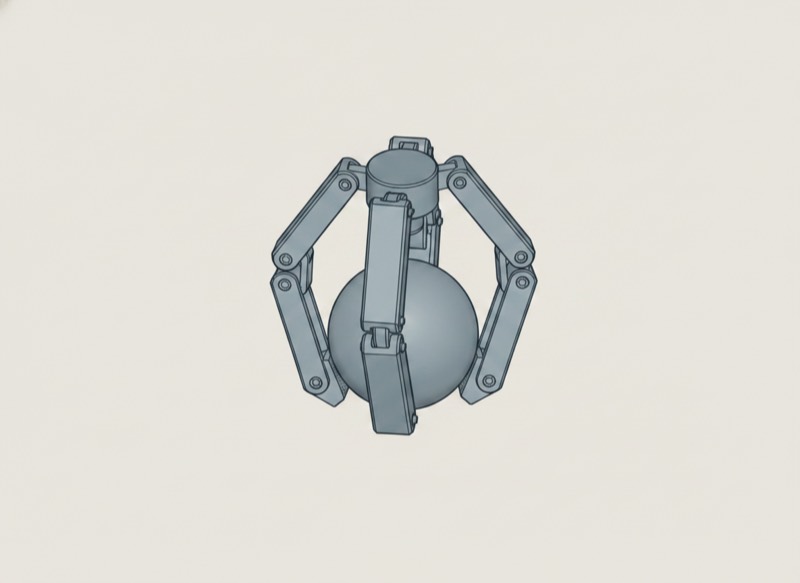
These are fingers that shape themselves to the object. Multi-link fingers are driven by fewer motors than they have joints, and springs and linkages distribute the closing motion so the finger wraps whatever it meets. Underactuation converts mechanical cleverness into grasp generality: a cylinder, a box, and an egg all get enveloped without the controller knowing the difference. Two- and three-finger adaptive grippers occupy the space between simple jaws and full dexterous hands, at a fraction of a dexterous hand's cost and fragility.
Strengths & weaknessesEnvelope grasps tolerate large pose errors and odd geometries, and passive adaptation needs no per-object programming. They are far cheaper and more robust than fully-actuated hands. The trade-off is control: you get the grasp the mechanism chooses rather than the one you specify. Precision fingertip manipulation is limited, the link mechanisms add wear points compared to plain jaws, and for known parts at volume a custom-fingered simple gripper beats them on cost and cycle time.
When to usePick adaptive grippers for mixed-SKU, irregular-geometry handling where pose uncertainty is real (kitting, unstructured picking, research platforms). Envelope grasps succeed there without per-object programming, and a full dexterous hand's cost and fragility aren't justified. If you're handling known parts at production volume, a custom-fingered simple jaw wins on cost and cycle time. If the task needs precise fingertip placement or in-hand repositioning, underactuation can't deliver it by design. In high-volume logistics, vacuum hybrids usually take the job first.
Key numbersPayload 1–10 kg · grip force 15–200 N · 2–4 motors driving 6–10 finger joints · close time 0.5–4 s · fingertip repeatability roughly ±0.05 mm, far looser once the finger wraps · unit cost $5–15k.
ExamplesRobotiq 3-Finger (the research classic), OnRobot's adaptive lines, RightHand Robotics' underactuated picking fingers (with suction hybrid), Yale OpenHand's open-source designs seeding a generation of research, Barrett Hand's pioneering three-finger lineage.
Economic profileThis is a $5–15k middle tier serving mixed-SKU handling and research, and its commercial position is squeezed from several sides: vacuum hybrids own high-volume logistics, custom jaws own known parts, and humanoid hands have taken the generality story with better funding. The design philosophy is doing better than the product category. Underactuation and compliance sit inside nearly every credible humanoid hand.
VideosYale OpenHand Project: Open-Source Underactuated Hands (Yale GRAB Lab) · Towards an Objective Evaluation of Underactuated Gripper Designs (arXiv)
Suction & field
vacuum and magnets that grab by surface, not shape4 effector types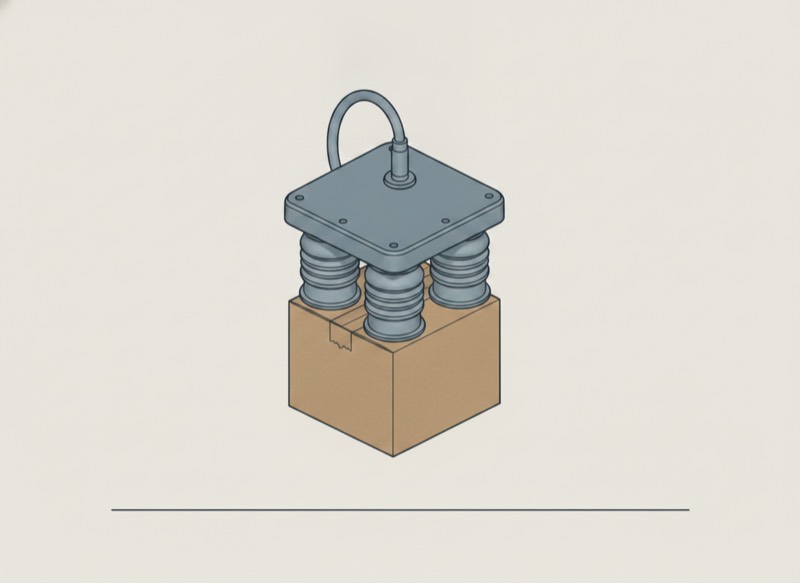
Vacuum cups do most of the picking in world logistics. Elastomer cups press against a surface, and vacuum from a venturi ejector or a pump lets atmospheric pressure itself clamp the object. One accessible face is the entire requirement. Cups attach in milliseconds, tolerate centimeters of positioning error, weigh grams, and cost dollars, and arrays of them lift everything from single envelopes to full appliance panels. Modern picking systems pair cup arrays with vision and flow sensing so each cup's grip can be verified.
Strengths & weaknessesCups attach faster than any other gripping method, need only one accessible face, tolerate large pose errors, and add almost no moving mass. Failures are cheap because cups are consumables, and arrays scale the approach from grams to hundreds of kilos. The weaknesses mostly come down to leaks: porous, curved, dusty, oily, or crumpled surfaces don't hold vacuum. The compressed-air bill is real (venturis are convenient and thermodynamically wasteful). Grip is normal-force only, so shear and peel are the directions in which it fails. The hiss and the dust movement rule cups out of some cleanrooms. And in e-commerce, every dropped parcel is a leak that beat the grip.
When to useDefault to cups for anything with one accessible, nonporous, reasonably smooth face (cartons, cases, panels, glass, sheet, most e-commerce goods), especially when attach speed and pose tolerance drive throughput. Arrays with per-cup flow sensing scale from envelopes to appliance panels. If the surface is porous, oily, crumpled, or perforated, or if the move loads the grip in shear or peel, look elsewhere: mechanical jaws for structured parts, foam-area vacuum for rough surfaces, magnets for ferrous sheet. Budget the compressed-air bill honestly, since smart ejectors do pay back, and track leak-driven drop rates per thousand picks as the real performance metric.
Key numbersCup diameter 5–200 mm · vacuum 60–85% of atmosphere · holding force roughly 20–40 N per 40 mm cup after a safety factor of 2–4 · attach time 20–100 ms · array payloads from a few grams to several hundred kg · cups $2–50 each, ejector or pump $100–2k.
ExamplesPiab, Schmalz, and SMC ecosystems (cups, ejectors, sensors); Amazon Robin/Cardinal/Sparrow's suction arrays; every palletizer and carton erector; sheet-metal and glass handling lines; egg and produce packing with food-grade silicone cups.
Economic profileThis is a consumables-rich oligopoly (Piab, Schmalz) with razor-blade economics, since cups wear out by design. On top of that sits an energy-efficiency upgrade cycle: smart ejectors with air-saving control, sold on opex reduction. Vacuum is the incumbent technology of robotic picking, so it's the benchmark. Any novel gripper pitch should state precisely which objects vacuum fails on and how many of those show up per thousand picks.
VideosVacuum Knowledge Base: System Design and Suction Cup Theory (Schmalz) · Grasp Failure Constraints for Multi-Suction-Cup Grippers (arXiv)
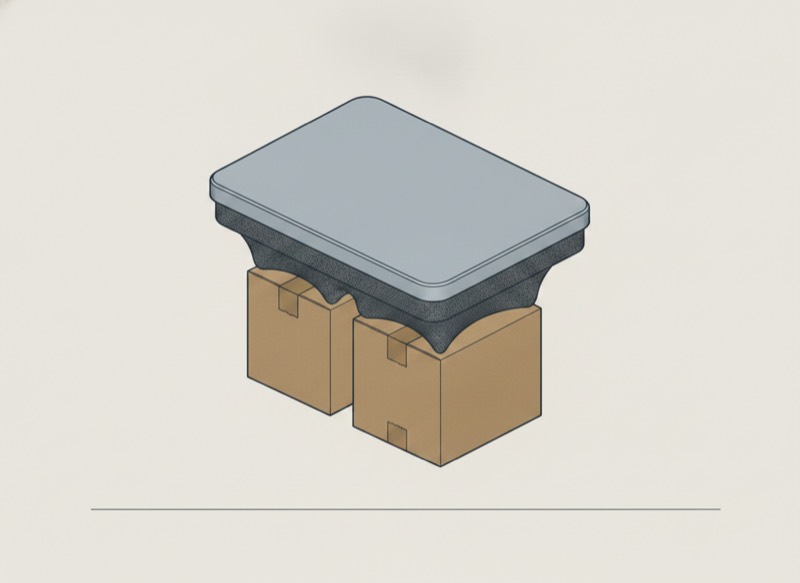
These are suction grippers you don't have to aim. A large foam-faced plate is riddled with vacuum holes, each with its own check valve or restrictor, so the gripper seals wherever the object happens to be and leaks harmlessly where it isn't. Depalletizing mixed layers, handling rough-sawn lumber, and grabbing whatever the conveyor delivers all become one motion: press the mat down, lift everything underneath. The foam conforms to curvature and texture that individual cups can't seal against.
Strengths & weaknessesThere is no targeting requirement, with position tolerance measured in tens of centimeters, and the gripper can take multiple objects at once for full layer picks. Foam seals rough and curved surfaces, and the mechanism is simple enough to be robust. On the other side, it is hungry for air flow, because the leak-tolerant design leaks by design. Foam faces are consumables that tear and clog. You get no per-object selectivity without zoned valving, which adds the cost back. Heavy objects with small footprints exceed the local suction, and delicate single-item work isn't what it's for.
When to usePick area grippers for depalletizing and layer picking, for rough or curved surfaces (sawn lumber, sacks, mixed cartons), and for any cell where positioning tolerance of tens of centimeters or multi-object picks matter more than aiming. Press the mat down and lift everything under it. Size the vacuum supply for a design that leaks on purpose. If you need selective single-item picking, you'll have to add zoned valving, which erodes the cost case. Heavy objects with small footprints will exceed the local suction. For delicate individual items, discrete cups with per-cup sensing are the right tool.
Key numbersGripper face roughly 0.1–2 m² · payload 20–500 kg depending on how much of the face seals · positioning tolerance in the tens of centimeters · attach time 0.1–0.5 s · air demand often several hundred NL/min, because the design leaks on purpose · unit cost $2–10k.
ExamplesSchmalz FXP/FMP series (the category standard) on depalletizing cells everywhere, Piab Kenos line, layer-picking systems atop palletizers, woodworking panel handling, bag and sack handling with reinforced foam faces.
Economic profileUnits run $2–10k and get justified wherever mixed or imprecise loads meet high throughput, and depalletizing is robotics' current volume application. The foam-and-valve consumable stream mirrors cup economics at larger ticket sizes. Sales track the warehouse automation wave directly: every "we depalletize anything" startup demo has one of these at the wrist.
VideosVacuum Area Gripping Systems FXP/FMP (Schmalz) · Kenos Large-Area Vacuum Gripping Systems (Piab)
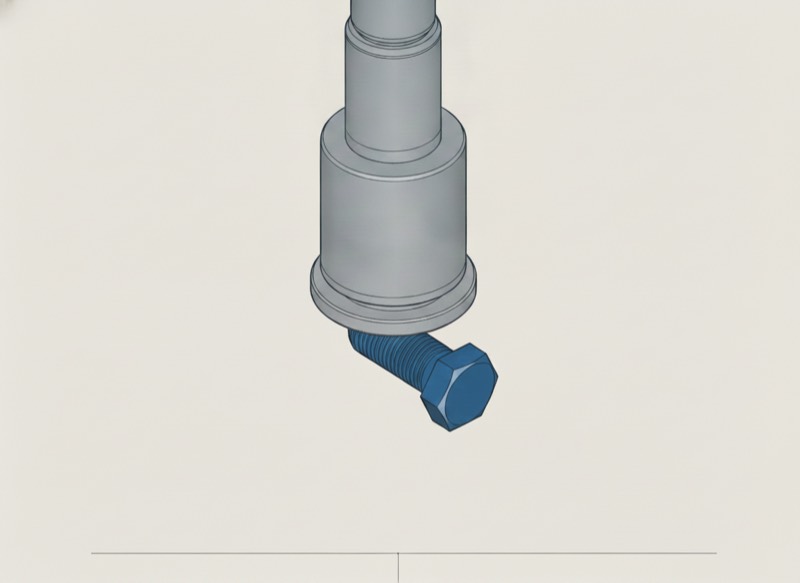
For ferrous work, the field does the gripping. Electropermanent magnets switch on and off with current pulses but hold with permanent-magnet force and zero power, so they grab sheet, plate, and machined steel through oil, scale, and light rust that defeat vacuum. There is no compressor, no consumable cups, and no requirement of the grip surface beyond it being steel. Pole extensions and multi-zone designs adapt one gripper to nested laser-cut parts or curved panels.
Strengths & weaknessesThe grip holds through a power loss, since the magnet is electropermanent. Oil and dust don't matter, and you get single-face access like vacuum without needing air. Switching is fast, and careful pole design separates thin sheets precisely. The big limit is that it works on ferrous material only, so the entire aluminum, plastic, and stainless world is invisible to it. Thin sheets grab their neighbors unless the field is shaped carefully. Residual magnetism can cause problems downstream, and swarf sticks to everything. Heat degrades magnets, and holding force depends on contact area and material thickness in ways that surprise people.
When to usePick electropermanent magnets for ferrous sheet, plate, and machined steel (laser-cutter load/unload, press lines, welding fixtures), especially where oil, scale, and dust defeat vacuum seals or where cutting the compressed-air tether pays. Holding through a power loss is a genuine safety upgrade over both vacuum and electromagnets. If the part is non-ferrous, the gripper simply does not see it, so aluminum, stainless, and plastic go to vacuum instead. For thin stacked sheets you need pole designs shaped for single-sheet separation. And if the next process will be contaminated by residual magnetism or clinging swarf, vacuum is the fallback.
Key numbersHolding force 100 N to several kN per pole · full rated force needs roughly 3 mm or more of steel · switch time 0.05–0.5 s on a current pulse · zero holding power, and the grip survives a power loss · unit cost $1–8k.
ExamplesMagswitch and SPD/Assfalg electropermanent units on sheet-metal press lines, laser-cutting load/unload cells, Schmalz and Goudsmit magnetic ranges, robotic welding fixtures, steel-service-center automation.
Economic profileThis is a solid niche ($1–8k) growing along with sheet-metal automation, and electropermanent technology has displaced always-on electromagnets for safety and energy reasons. Ferrous physics bounds the market, so it will never generalize, and it doesn't need to. In fab shops it is the obvious answer, and obvious answers with switching-cost-free reliability make excellent, quiet businesses.
VideosElectronic Magnetic Grippers for End-of-Arm Tooling (Goudsmit Magnetics) · How Switchable Permanent Magnets Work (K&J Magnetics)

These grip by surface physics. Electroadhesive pads induce electrostatic attraction against almost any material (fabric, foil, cardboard, glass) using kilovolts at microamps. Gecko-inspired dry adhesives use micro-structured fibrils whose van der Waals contact switches on with shear load and releases with a peel. Both grab where vacuum leaks and magnets do nothing: porous textiles, perforated sheets, in-vacuum wafers, and space debris.
Strengths & weaknessesThey work on porous and non-ferrous surfaces, use nearly zero energy (electrostatic) or truly zero energy (gecko), run silently, need no air, and function in hard vacuum, which is where the space and semiconductor interest comes from. Holding pressures are modest, a fraction of vacuum's, so payload per unit area disappoints. Electroadhesion charges dust onto the pad and degrades with humidity. Gecko fibrils foul and wear, so they need cleaning cycles. Release timing depends on charge decay, which complicates fast cycles. And industrial track records remain thin.
When to useReach for these only where vacuum and magnets are physically disqualified: limp porous textiles and composite plies that leak air, perforated sheet, and in-vacuum handling of wafers or space hardware where there is no atmosphere to press with. Near-zero power and silence are a bonus in those settings. Prototype against your actual materials and humidity before committing, because holding pressure is a fraction of vacuum's. For mainstream picking of sealable surfaces, vacuum wins on force, speed, and track record. Treat any general-gripping pitch built on these mechanisms with the skepticism the category's commercial history deserves.
Key numbersElectroadhesive holding pressure roughly 0.5–5 kPa, against 60–80 kPa for vacuum · drive voltage 1–10 kV at microamp currents, under 1 W per pad · gecko dry-adhesive shear stress roughly 10–100 kPa · release by peel in well under a second · payload usually under 1 kg per pad · unit cost $500–5k where products are still sold.
ExamplesGrabit's electroadhesive sheet handlers (Nike shoe-upper stacking, the best-known win; the company later faded), gecko grippers on Stanford/JPL space-debris demos and ISS experiments, OnRobot's briefly-sold Gecko line, textile and composite-ply handling pilots.
Economic profileThe category has been promising for a long time and commercially fitful. Each mechanism owns real niches (limp textiles, in-vacuum handling), but those niches are individually small, and the flagship vendors have repeatedly stalled. The apparel-automation prize (sewing's limp-fabric problem) keeps venture interest alive. The right posture is to back application-specific bets where vacuum physically cannot compete, and to discount general-gripping stories.
VideosElectroadhesion Technologies for Robotics: A Comprehensive Review (University of Bristol / IEEE T-RO) · Gecko Toe Pad-Inspired Robotic Gripper with Rapidly and Precisely Tunable Adhesion (PMC)
Soft & compliant
gentle grasping of fragile, irregular objects2 effector types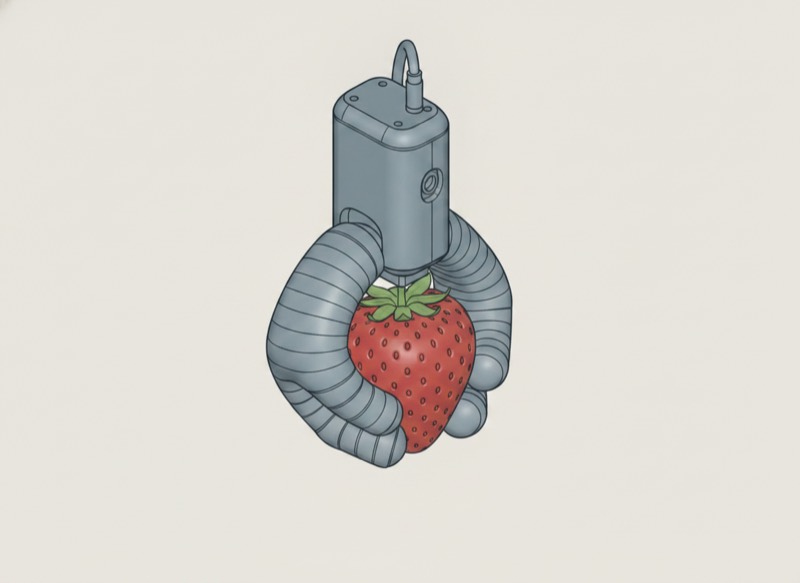
These are fingers with no rigid skeleton. Molded elastomer digits (pneumatic bellows that curl when inflated, or passive fin-ray structures that wrap on contact) grasp by conforming rather than by computing. A strawberry, a live crab, and a bag of chips all get held by the same gripper with the same command, because the mechanics does the object modeling. Food processing adopted them first, since a single-piece silicone finger has no crevices to trap contamination and can handle produce at line rates no careful rigid gripper matches.
Strengths & weaknessesThey are gentle by construction, because the inflation pressure limits the force. They tolerate a wide range of shapes without sensing or programming, forgive pose error, and their monolithic construction stands up to washdown. The trade-off is precision: placement accuracy and grip stability trail rigid fingers, and payload is modest. Elastomers wear, tear, and fatigue, so the fingers are consumables. Pneumatic versions need air and valving, and inflation dynamics hold down cycle rates. Oil and some CIP chemicals attack certain elastomers.
When to usePick soft fingers for delicate, shape-variable products under hygiene rules (produce, bakery, proteins, anything washdown-regulated), where gentleness has to be guaranteed by construction rather than by control and moderate line rates are acceptable. Fin-ray fingertips are also a cheap upgrade for pose-tolerant grasping on an ordinary gripper. If placement precision, payload, or cycle rate dominates, vacuum and rigid jaws are faster and stiffer. Verify elastomer compatibility with your cleaning chemicals and oils before committing, because fingers are consumables and the wrong material shortens an already finite life.
Key numbersPayload usually 0.1–5 kg · actuation pressure 0.3–3 bar, well under a pneumatic jaw's 6 bar · grip force roughly 5–50 N per finger · cycle time 0.3–1 s, limited by inflation dynamics · one actuated degree of freedom per finger, and none on passive fin-ray designs · unit cost $500–5k, with replacement fingers tens of dollars each.
ExamplesSoft Robotics Inc's mGrip food lines (the category's commercial proof, since acquired into Schmalz's orbit), Festo's adaptive fin-ray fingers, Rochu and other Chinese soft-gripper vendors, bakery/produce/protein picking cells, fin-ray fingertips printed by countless integrators.
Economic profileFood automation is what made soft gripping a real business. Hygiene rules and labor scarcity in proteins and produce pay the premium, and fingers-as-consumables provide recurring revenue. Outside food, soft fingers compete with vacuum and usually lose on speed. The IP moat is thin, since fin-rays print anywhere. The durable positions are food-grade certification, materials know-how, and line integration.
VideosmGrip Soft Finger Grippers for Food Handling (Schmalz) · Soft Robotic Grippers: A Review (Frontiers in Materials)
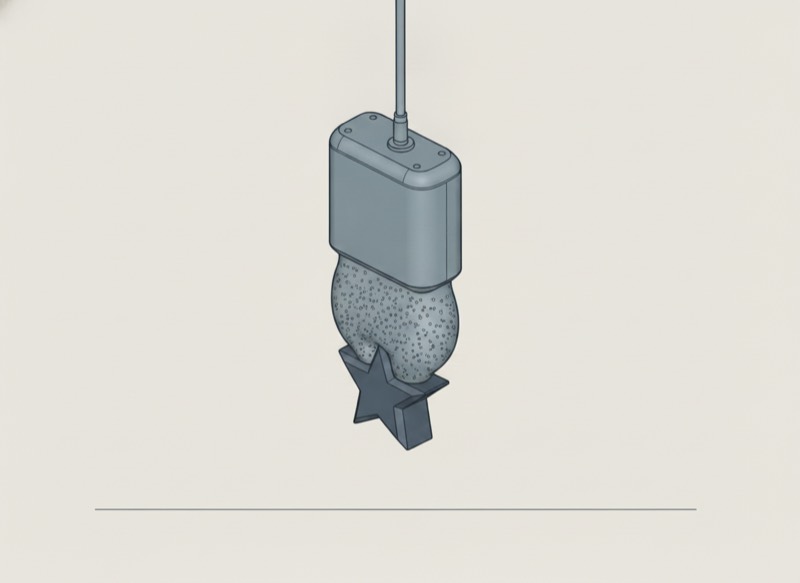
This is a balloon full of coffee grounds that works as a hand. You press the soft, grain-filled membrane onto an object and pull vacuum, and the granules jam into a rigid solid molded perfectly to the object's shape. The custom fixture forms in a hundred milliseconds and releases just as fast. The 2010 Cornell/Chicago "universal jamming gripper" became one of robotics' most famous demos because the mechanism does the thinking: no fingers, no planning, no object model.
Strengths & weaknessesIt grasps wildly irregular shapes with zero programming, and the conforming contact spreads force gently. The hardware is simple (a bag, grains, and a vacuum line), and it holds odd orientations rigid enough for machining-adjacent tasks. The catch is that it has to push down on the object against a support, so bin walls and neighboring parts interfere. Flat, large, or porous objects defeat the envelope. Membranes puncture and wear against anything sharp. Grains fatigue and clump with humidity. Release can eject small parts unpredictably, and the vacuum plumbing takes back some of the simplicity.
When to useConsider jamming only for oddly-shaped rigid parts presented on a supportive surface with clearance to press down: short-run kitting of irregular parts, or instant custom fixturing that holds strange geometries rigid for secondary operations. It works best exactly where fingers would need programming and cups can't seal, provided nothing sharp meets the membrane. Avoid bins with walls and close-packed neighbors, flat or large or porous objects, and anything that needs predictable release placement. In nearly every general-picking scenario vacuum or soft fingers is slightly better, which is why the standalone category failed. Think of jamming as a variable-stiffness component to put inside something else rather than as a default gripper.
Key numbersMembrane diameter typically 50–100 mm · payload usually under 1 kg, holding force a few N to tens of N · jam and release each take roughly 0.1 s · vacuum 0.7–0.9 bar below atmosphere · zero actuated degrees of freedom, since the grains do the shaping · no catalog product on sale since 2017.
ExamplesThe Empire Robotics VERSABALL (the best-known commercialization, shut down in 2017), Nichols/Formhand jamming pads for kitting, research fixtures for odd-part machining, jamming-stiffened surgical and wearable devices (where the principle is more active today).
Economic profileThe mechanism is clever, but the market kept being adjacent. For every jamming use case, either vacuum or soft fingers was slightly better, or an object violated the press-down requirement. Jamming's real commercial future looks like a component (variable-stiffness elements inside other effectors and wearables) rather than a standalone gripper category. It is a textbook study in the gap between a demo and a product.
VideosUniversal Robotic Gripper Based on the Jamming of Granular Material (arXiv) · Granular Jamming in Soft Robotics: Simulation Frameworks and Emerging Possibilities (Biomimetics)
Dexterous hands
human-like manipulation, generality over cost1 effector type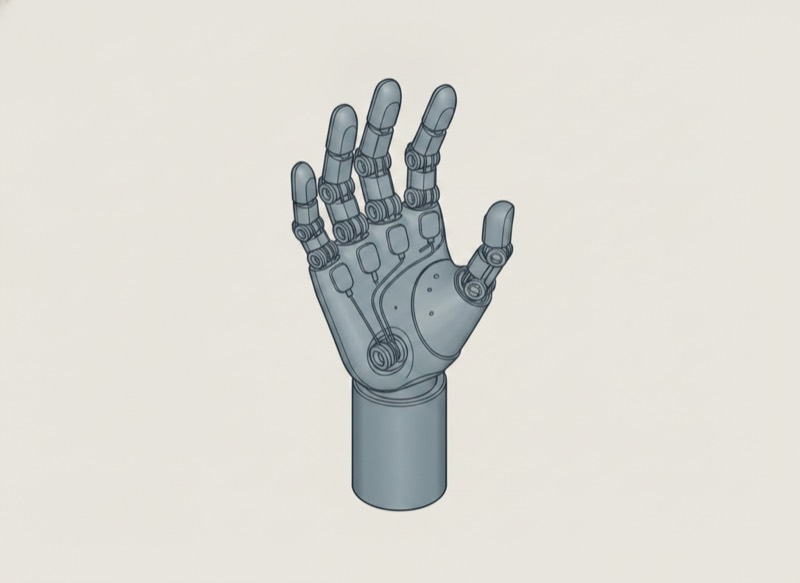
This is the anthropomorphic bet: hands with articulated fingers, opposable thumbs, and (increasingly) dense tactile sensing, built to manipulate anything a human hand can, including reorienting objects in-hand, using human tools, and exploiting the full grasp taxonomy. The category spans two very different animals with the same silhouette. Research instruments maximize articulation to explore what's possible. Production humanoid hands deliberately subtract articulation until reliability and unit cost work at fleet scale. Together they exist to answer the field's deepest question: whether general manipulation is a hardware problem, a learning problem, or both.
Strengths & weaknessesThis is the only effector class that can attempt the full human task distribution, and it is the substrate for manipulation learning (in-hand reorientation, tool use, imitation from human video). The weaknesses are mostly about wear. Fingers meet the world first and hardest, so hands are the least reliable subsystem of every humanoid, and tendons, joints, and tactile surfaces are all wear items. Research units are lab-fragile by construction. When you already know the task in advance, simpler tooling (jaws, suction, changers) remains cheaper, faster, and more reliable, so dexterity has to justify its premium on task generality alone.
Variants16–24 actuated DoF, tendon-driven, maximal sensing: Shadow Dexterous Hand (~$100k+, OpenAI's Rubik's-cube work), Wonik Allegro (the decade-long research default), LEAP Hand ($2k open-source, the cost collapse that put dexterity research within reach of ordinary lab budgets). They get maintained like lab instruments, with regular retensioning and rebuilds.
6–16 DoF, underactuated and compliance-protected, engineered for manufacture, service-swap, and consumable fingertips: Tesla Optimus's tendon-driven hands, Figure's iterations, Sanctuary's hydraulic fingers, 1X's compliant design. These ship attached to robots rather than being sold as hands, though a component-supplier tier is now forming.
Pick a dexterous hand only when task generality is itself the product: humanoid platforms facing open-ended task distributions, manipulation research, and teleoperated data collection for learned policies. LEAP-class $2k open hardware suits research budgets, and production-style underactuated hands suit cases where fleet reliability matters. If your task set can be enumerated, which covers nearly all deployed automation, a parallel jaw, suction, or a tool-changer portfolio beats a hand on cost, cycle time, and MTBF. Before specifying one, answer honestly what fraction of your tasks needs more than a pinch.
Key numbers6–24 actuated degrees of freedom, against 1 on a parallel jaw · payload 0.5–5 kg per hand · fingertip force roughly 5–20 N · fingertip repeatability around 1 mm · unit cost $2k for LEAP-class open hardware up to $100k+ for a Shadow Hand.
ExamplesOpenAI's cube manipulation (Shadow), academic in-hand-reorientation and tool-use research on Allegro/LEAP, teleoperated data collection for manipulation foundation models, Optimus/Figure demos folding laundry and sorting objects (the production camp's public benchmarks).
Economic profileTwo economies share one anatomy. The first is a tiny research-instrument market (~$10–50M/yr) that matters far more than its size suggests, because it is the R&D bench and the training-data source for the production wave. The second is a potential tens-of-millions-of-units component market if general-purpose humanoids ship, with razor-blade fingertip economics. One open question prices both: what fraction of deployed humanoid tasks actually needs more than a pinch? If the answer is "most," hands become the strategic component of the era. If it's "few," humanoids ship with two-finger grippers and the premium collapses.
VideosShadow Dexterous Hand Series (Shadow Robot) · Learning Dexterous In-Hand Manipulation (arXiv)
Process tools
tools that work the part: weld, cut, spray, fasten4 effector types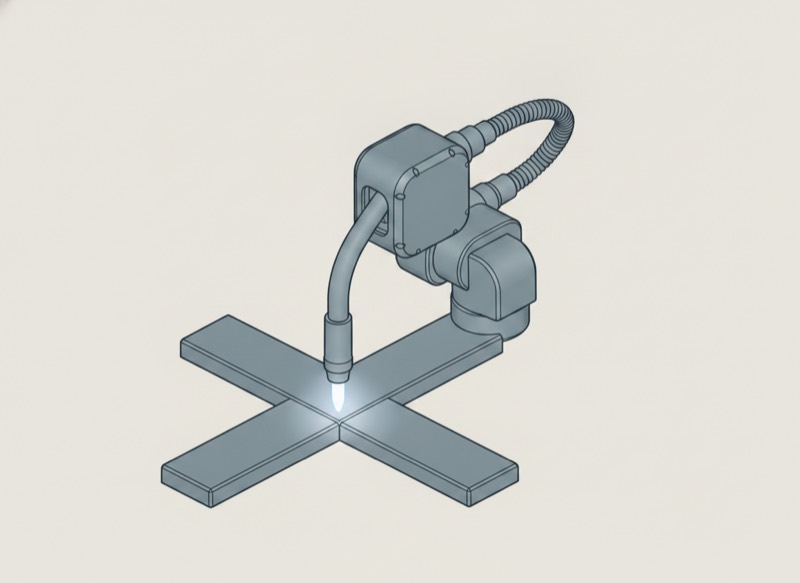
This is the end effector that built robotic automation. MIG/MAG torches, spot-weld guns, laser heads, and plasma cutters at the wrist made welding the first and still one of the largest robot applications on earth. A torch is a process instrument rather than a gripper, since wire feed, shielding gas, current waveform, and seam tracking all flow through it. The surrounding ecosystem (positioners, cleaners, calibration, offline programming) is what a "welding robot" actually is.
Strengths & weaknessesDecades of refinement have made these reliable in a harsh environment of spatter, heat, and fumes, and process quality exceeds hand-welding consistency. Vendors offer complete ecosystems from the torch through the software. On the cost side, spatter and tip wear make consumables (tips, nozzles, liners) a perpetual expense. Torch collisions and calibration drift ruin seams without any obvious warning. Each process (MIG, TIG, spot, laser) is its own product line and skill base. And the adoption bottleneck is programming and fixturing effort rather than the torch, which is what cobot welding startups target.
When to useAutomate the torch when part volume and seam repeatability can repay the cell engineering (body-in-white, EV battery trays, recurring fab-shop weldments), or when the welder shortage makes a $120k cobot welding package cheaper than a position you can't fill. Judge feasibility on fixturing and programming effort rather than on torch capability, because that is where projects die. Match the process to the product deliberately: MIG for job shops, spot for sheet assemblies, laser for battery and precision work. For true one-offs with a heavy fixturing burden, a human welder is still the right tool unless modern cobot software genuinely closes the programming gap for your parts.
Key numbersRobotic MIG torch rated 300–500 A, water-cooled types at 100% duty cycle · wire feed 2–15 m/min and travel speed 0.3–1.5 m/min · spot gun electrode force 2–6 kN with weld times of 200–400 ms · torch $1–5k, robot spot gun $15–30k · complete cobot welding package around $120k.
ExamplesFronius, Lincoln, ESAB, and Binzel robotic torch lines; resistance spot-guns by the hundred thousand in every car body shop; laser welding heads (IPG, Trumpf) on EV battery trays; cobot welding packages (Vectis, Hirebotics, Cobot Systems) bringing torches to job shops.
Economic profileThis is a mature, consumables-rich market riding two growth waves: EV battery and body welding, and the welder-shortage-driven cobot welding boom that brings automation to five-person fab shops. The torch itself sits in a stable oligopoly. The venture action is in the software and fixturing wrapper that makes a $120k welding cell deployable by a shop with no robotics engineer.
VideosRobotic Welding Systems Overview (Fronius) · Active Visual Sensing Methods for Robotic Welding: Review and Tutorial (arXiv)
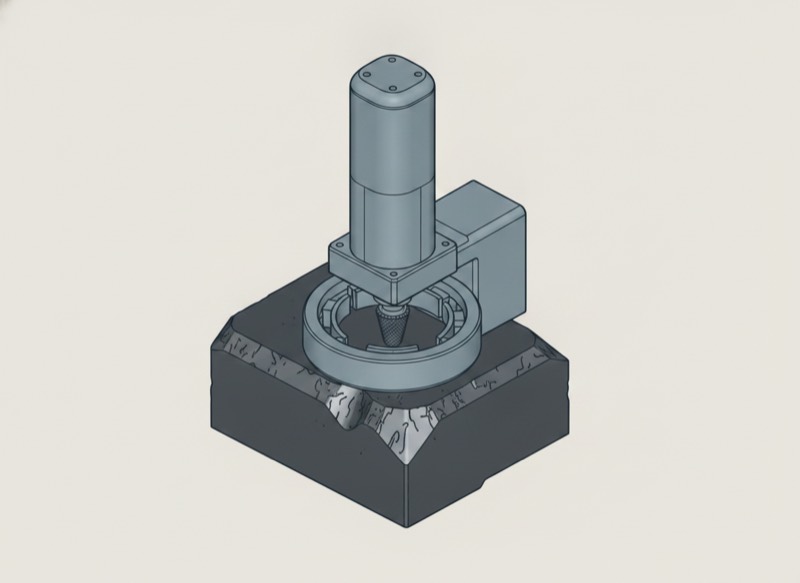
This is machining at the wrist. Electric or air spindles carry burrs, sanding discs, brushes, and polishing media, which turns robots into deburring, grinding, and surface-finishing machines. The category's defining component is active compliance: force-controlled flanges and radially-compliant tool holders that maintain constant contact pressure along uncertain part surfaces. That converts a position-controlled robot into a tool that follows the surface the way hand finishing does.
Strengths & weaknessesIt removes some of manufacturing's worst manual jobs (grinding dust, vibration injuries), so the ergonomic case usually carries the sale. Active compliance absorbs part-to-part variation, and cells can run lights-out on castings and welds. On the cost side, abrasives are aggressive consumables and require wear-compensation logic. Dust and grit attack the robot itself, so you want sealed or protected models. Material-removal rates trail dedicated machines, and process development per part family is real engineering. Acoustic and vibration coupling also limit finish quality compared to CNC.
When to usePick robotic finishing for deburring, grinding, and polishing of castings, welds, and composites where the manual job is injurious and the position is unfillable, since the ergonomic mandate makes it automation's easiest sale. Treat an active force flange or a radially-compliant holder as non-negotiable whenever part surfaces vary. Budget real process development per part family, plus wear-compensation logic for the abrasives. If material-removal rate or finish tolerance demands a machine tool, use one: robot stiffness and vibration coupling set a ceiling that CNC does not have. And protect or seal the robot itself, because grinding dust eats the machine doing the grinding.
Key numbersSpindle speed 5,000–65,000 RPM at 0.1–5 kW · active flange force range 10–200 N over 10–30 mm of stroke · surface finish typically Ra 0.2–3.2 µm depending on media and passes · robot stiffness roughly 1 N/µm against 20–50 N/µm for a machine tool · compliant tools and spindles $1–5k, with active force flanges costing more.
ExamplesATI and Schunk radially-compliant deburring tools, PushCorp and FerRobotics active force flanges (the enabling components), robotic foundry cleaning cells, aerospace composite trimming, cutlery and sanitary-ware polishing lines in Asia, cobot sanding packages for woodshops.
Economic profileThis is a steadily growing niche powered by labor scarcity in the finishing trades and OSHA-adjacent pressures, since jobs nobody wants are automation's easiest sale. Force-control flange vendors occupy the strategic component slot, because every integrator buys one. Consumable abrasives plus process recipes create sticky aftermarket revenue. The constraint on growth is application engineering capacity rather than demand.
VideosRobotic Material Removal Tooling Explained (PushCorp) · Compliant Robotic Deburring Tools (ATI Industrial Automation)
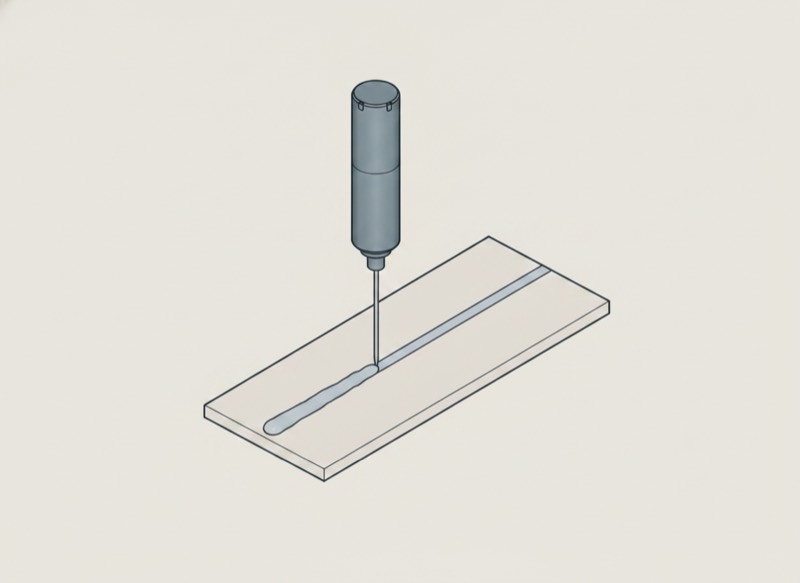
Robots apply fluids with a consistency people can't match. Adhesive and sealant dispensers meter beads to fractions of a milliliter, paint atomizers spin at 60,000 RPM and use electrostatic charge to wrap the spray around car bodies, and dosing valves lay thermal interface materials on EV battery packs. Path consistency is the product: a robot lays the same bead at the same rate forever. In painting, the gain in transfer efficiency (less overspray) pays for the robot in material savings alone.
Strengths & weaknessesThe consistency is impossible to reach manually. Electrostatic rotary atomizers reach 80–95% transfer efficiency against ~40% for hand spraying. Automation also takes humans out of hazardous environments (isocyanates, solvent booths), and metering precision is what makes modern EV assembly possible (gap fillers, fire barriers). The weaknesses come from the fluid. Systems clog, cure, and drip, so purge-and-clean cycles are the operational tax. Viscosity drifts with temperature, which demands closed-loop metering. Paint robots are explosion-rated capital items. And every material change is a requalification.
When to useAutomate fluids wherever bead or coating consistency at volume is the product: paint lines (where 80–95% transfer efficiency against ~40% by hand pays for the robot in material alone), body-shop sealing, EV battery TIM and fire-barrier dosing, and conformal coating. The same holds for any application that removes humans from isocyanate and solvent exposure. Spec closed-loop metering when viscosity or dose tolerance is tight. If your work is low-volume and high-mix, purge cycles and per-material requalification will dominate the economics. Treat every material change as an engineering event with its own validation rather than as a parameter tweak.
Key numbersRotary bell atomizer 30,000–70,000 RPM · transfer efficiency 80–95% with electrostatics, against roughly 40% for hand spraying · adhesive beads 1–10 mm wide metered to within a few percent of target volume · material viscosity from 100 cP to over 1,000,000 cP across the range · dispensing valve $2–10k, explosion-rated paint robot $80–200k.
ExamplesDürr, ABB, and Fanuc paint-shop ecosystems (every automotive paint line on earth), Graco and Nordson dispensing valves, SCA/Atlas Copco sealing systems in body shops, EV battery TIM and fire-barrier dispensing cells (the current growth area), conformal coating in electronics.
Economic profileAutomotive painting is one of robotics' oldest solved markets, an oligopoly with decades of process moat. The new money is in EV batteries: every pack needs meters of precisely-dosed adhesives, gap fillers, and thermal materials, so dispensing benefits from electrification roughly in proportion to cell production itself. Materials suppliers (Henkel, Sika) and equipment vendors jointly own the recipe lock-in.
VideosAutomotive Paint Robots and EcoBell Atomizers (Dürr) · Thermal Interface Materials and Gap Fillers for EV Batteries (E-Mobility Engineering)
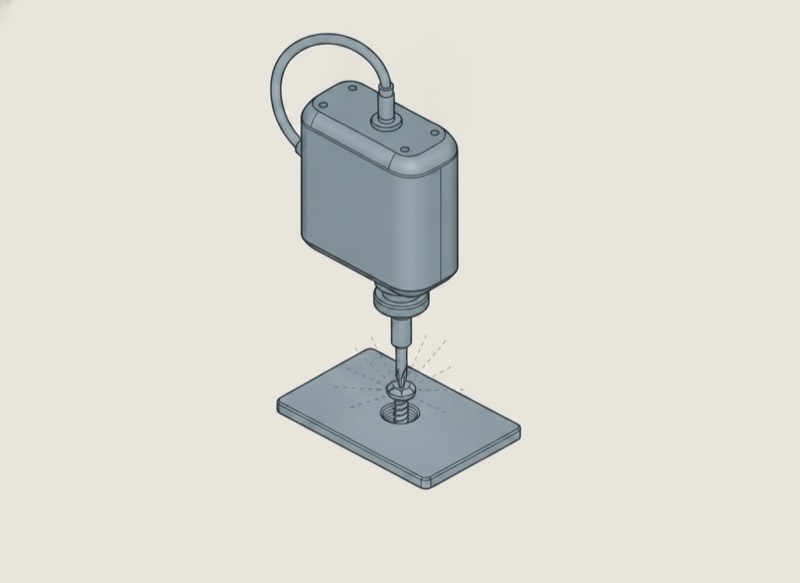
Screwdriving is assembly's most repeated act, and this is the automated version. Servo-driven spindles with torque-angle control run screws to specification and record the torque-angle curve of every fastener as legal-grade quality evidence, which is the part that matters. Feeding is half the machine: blow-feed tubes, vibratory bowls, or vacuum bit-holders deliver screws to the bit at rates hand assembly can't match. Nutrunners scale the same discipline to wheel bolts and structural joints.
Strengths & weaknessesJoint quality is calibrated and traceable, with torque curves archived per vehicle per screw, and that archive is the backbone of automotive compliance. Rates run past 1,500 screws per shift with no fatigue errors, and the torque signature detects cross-threading and missing screws. The main weakness is feeding. Screw feeding is a perpetual jam-and-tune discipline, and feed reliability rather than driving is what limits uptime. Each screw geometry needs its own feed setup, cross-threading recovery logic is real engineering, and flexible high-mix assembly still favors humans holding drivers.
When to usePick automated screwdriving when fastener count and traceability justify the cell: automotive and regulated assembly where archived torque-angle curves are the compliance record, or electronics lines running thousands of identical micro-screws per shift. Evaluate vendors on feed-system reliability, because feeding rather than driving decides uptime. Standardize your screw geometries before automating, since every variant is its own feed setup. If you're running high-mix, low-volume assembly with diverse fasteners and orientations, a human with a calibrated driver stays cheaper and much more flexible.
Key numbersTorque 0.02–10 N·m on electronics spindles and 10–1,000 N·m on nutrunners · torque accuracy within roughly ±3–5% of setpoint · cycle time 1–3 s per screw, past 1,500 screws per shift · screw sizes M1.6 to M8 on most feed systems · servo spindle and controller $2–8k, complete cobot screwdriving kit $5–15k.
ExamplesAtlas Copco and Bosch Rexroth tightening systems (automotive final assembly's standard), Desoutter and Estic spindles, OnRobot and Kolver cobot screwdriving kits, electronics assembly micro-screw cells (phone manufacturing runs on them), Weber and DEPRAG feed systems.
Economic profileThis is really a quality-documentation business that looks like a tool business, since automotive and aerospace pay for the audit trail as much as for the automation. The economics are stable oligopoly economics, with cobot kits expanding sales into general industry. The strategic tailwind is re-shored electronics and EV assembly, and screw feeding is the perennial bottleneck where clever startups keep finding niches.
VideosPocket Guide to Tightening Technique (Atlas Copco) · Screwdriving Robots as a Driver of Industrial Automation (DEPRAG)
Infrastructure
tool changers and compliance behind the gripper2 effector types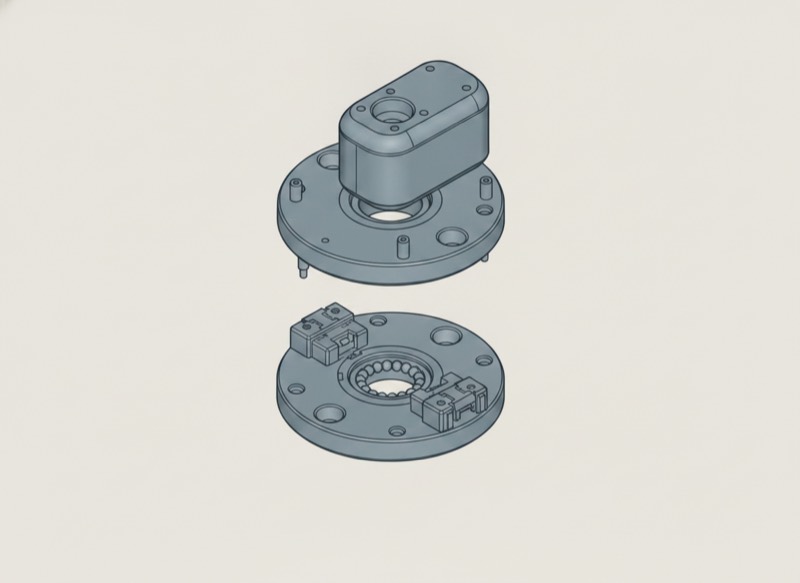
A tool changer is a locking coupler between the wrist and the tool. It passes mechanical load, air, power, signals, and fieldbus through a repeatable interface, so one robot can swap between gripper, torch, and spindle in seconds. That turns the effector decision from an either/or into a portfolio: a docked rack of tools makes a single robot a multi-process cell. In humanoid strategy debates, the changer is the standing counterargument to the universal hand.
Strengths & weaknessesOne robot can run many processes, which transforms capital utilization. Repeatability of microns preserves calibration across swaps, pass-through utilities avoid re-cabling, and manual versions serve low-frequency changeover cheaply. On the weak side, every coupling is a failure point, and pass-through pins and seals multiply the count (contamination in the interface is the classic fault). Swap time of 5–15 s taxes cycle-driven applications. Tool racks consume floor space, and the tool inventory multiplies cost. Dropped-tool safety logic has to be engineered rather than assumed.
When to usePick a changer when one robot must run multiple processes (weld then handle, machine-tend then deburr) or serve a part mix no single tool covers, and when changeover happens every few minutes to hours rather than every cycle. Manual changers cover low-frequency swaps at a fraction of the cost. Engineer the dropped-tool safety and keep the pass-through interface clean, since contaminated pins are the classic fault. In cycle-time-critical single-process cells the 5–15 s swap and the added failure interfaces are pure tax, so bolt the one right tool on permanently, or add a second robot before you add a tool rack.
Key numbersPayload 5 kg on cobot-size couplers to over 1,000 kg on press-tending units · swap time 5–15 s automatic, a minute or more for a manual changer · repeatability of a few microns across swaps · rated for millions of lock cycles · coupler pair $500–5k, before the tools and the rack.
ExamplesATI (the category leader) and Schunk/Stäubli changer lines from cobot-size to 1-tonne press-tending units, Kosmek and BL Autotec in Asia, OnRobot's quick changers for the cobot ecosystem, multi-tool welding-plus-handling cells throughout automotive.
Economic profileThis is a quietly excellent components business: high margins, proven demand, and a position that wins regardless of which effector fashion prevails, because more tools per robot means more changers. The cobot wave added a low-end volume tier. Its strategic meaning in the humanoid era is real: if task-specific tools plus changers stay cheaper than dexterous generality, the changer takes the role of the hand.
VideosRobotic Tool Changer Selection Guide (ATI Industrial Automation) · Tool Changer Applications and Engineering Considerations (ATI Industrial Automation)
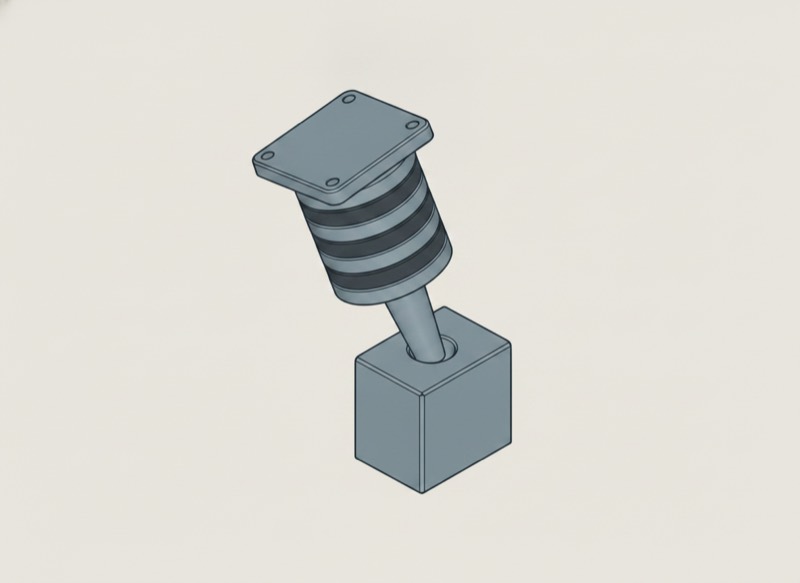
These devices build forgiveness into the tool mount. A remote-center-compliance (RCC) device is an elastomer-and-shim structure between the wrist and the tool. It puts the compliance's rotation point at the part's tip, so a slightly-misaligned peg self-centers into its hole and jamming contact forces turn into corrective motion. The design is purely passive, was invented at Draper Labs in the 1970s, and still solves insertion problems that vision and force control handle with far more expense. Active versions (voice-coil or pneumatic axes) add controlled compliance and position feedback.
Strengths & weaknessesIt solves peg-in-hole misalignment mechanically, in microseconds, with zero sensing, zero programming, and zero compute, and the hardware is cheap, robust, and maintenance-light. The catch is that each device is tuned per task: the compliance center's location depends on part length, so a tool change may need a device change. Passive also means uncontrolled, since it always complies, including when you wish it wouldn't. The misalignment capture range is limited, elastomers age, and modern force-controlled robots absorb some of its role in software.
When to usePick an RCC for defined, repeated insertions with small misalignment (connectors, dowels, bearings, shafts), where a $1–3k passive device replaces a $15k force-control package and reacts in microseconds instead of control-loop time. Size the compliance center to the part length and it simply works. Crash-protector variants are cheap insurance on any tool worth more than they are. If you have varied insertion families, each part length needs its own tuning, which gets awkward. If misalignment runs past the capture range, you need a search strategy anyway. And if the arm's built-in force control already handles the insertion, you may not need one, though check the passive device's price before assuming software is cheaper.
Key numbersLateral compliance roughly ±1–3 mm and angular ±1–3° · compliance center projected 50–300 mm ahead of the mount, matched to part length · reacts mechanically in microseconds, against milliseconds for a control loop · payload 1–30 kg · passive device $1–3k, against about $15k for a force-control package.
ExamplesATI and Schunk RCC lines descended from the Draper design, insertion stations in connector and bearing assembly, active compliance flanges (FerRobotics, PushCorp — shared with finishing), spring-loaded "crash protectors" (the RCC's cousin that saves tools from collisions), dowel and shaft-fitting cells everywhere.
Economic profileThis is a small, permanent market with the best cost-benefit ratio in assembly automation, since a $1–3k passive device routinely replaces a $15k force-control package for defined insertions. Its intellectual legacy is larger than its revenue. The RCC's lesson (put intelligence in the mechanics when you can) is the founding argument for underactuated hands and soft robotics, which covers a good share of this sheet.
VideosHow Remote Center Compliance Compensators Work (ATI Industrial Automation) · Selecting a Compensator: Misalignment and Clearance Calculation (ATI Industrial Automation)
No effector types match the current filters.
Try clearing a facet or broadening the search.
Glossary
Terms that show up in the effector explorer and are not obvious from outside the trade. Numbers are typical values, not specifications.
| Term | What it means |
|---|---|
| Cobot | A collaborative robot, meaning one rated to work next to people without a safety fence. Cobot cells created the market for plug-and-play electric grippers sold through ecosystem catalogs like UR+, usually specified by people who are not robotics engineers. |
| Compliance | How much a tool gives way under contact force instead of holding rigid. Passive compliance comes from springs and elastomers and reacts instantly; active compliance comes from a force-controlled flange or force-sensing joints and can be commanded. Any process that touches a part whose surface varies needs one or the other. |
| Deburring | Removing the ragged edges a cutting or casting process leaves behind. It is a natural robot job because it is repetitive and unpleasant, and it needs constant contact force along a path the part's own variation keeps moving, which is why it depends on compliant tool holders rather than on robot accuracy. |
| Degrees of freedom (DoF) | The number of independently actuated joints in an effector. A parallel jaw has one, a soft finger has one per finger, and a dexterous hand has 6–24. More DoF means more of the grasp is chosen by the controller and less by the mechanism. |
| Dexterous hand | A multi-finger hand with enough actuated joints to reposition an object within the grasp rather than just hold it. Research-grade units run 16–24 DoF and cost $100k and up. Fingers meet the world first and hardest, so tendons, joints, and tactile surfaces are all wear items and hands are the least reliable subsystem on a humanoid. |
| Dispensing | Metering a controlled amount of adhesive, sealant, paint, or fluid onto a part. Bead dispensers meter to fractions of a milliliter, and paint atomizers spin at 60,000 RPM and charge the spray electrostatically so it wraps around the body. Viscosity and temperature both move the flow rate, so the process is calibrated rather than set. |
| Electroadhesion | Gripping by electrostatic attraction. A pad at 1–10 kV and microamp currents induces charge in the object and holds at roughly 0.5–5 kPa, well under vacuum's 60–80 kPa. It works on porous and non-ferrous materials that leak air. |
| Electropermanent magnet | A magnet switched on and off by a current pulse that then holds with permanent-magnet force and no power. The grip survives a power loss, which is why electropermanent units replaced always-on electromagnets in sheet-metal handling. |
| End effector | Whatever is bolted to the end of the robot arm to do the actual work: a gripper, a torch, a spindle, a dispenser. The arm is a general-purpose positioner and the end effector is what makes the cell specific, which is why it usually carries most of the integration effort. |
| Envelope grasp | A grasp that wraps the object between whole finger surfaces instead of pinching it between fingertips. Envelope grasps tolerate large pose errors and odd geometries, and they give up fingertip precision to get it. |
| Fin ray effect | A finger structure whose cross-braced ribs make it bend toward whatever it is pressed against, with no actuator involved. Fin-ray fingertips cost tens of dollars, print in-house, and add pose tolerance to an ordinary gripper. |
| Fixturing | Holding a part in a known position so the robot can work on it. It is often the larger share of the engineering in a cell, since a robot that cannot see cannot compensate for a part that moved. Poor fixturing shows up as a gripper problem, and the fix is usually upstream of the gripper. |
| Force-control flange | An active device between the wrist and the tool that holds a set contact force, typically 10–200 N over 10–30 mm of stroke, while the robot follows a nominal path. It is what makes robotic sanding and deburring work on parts that vary. |
| Gecko adhesive | A dry adhesive covered in microscopic fibrils that grip by van der Waals contact, switching on under shear load and releasing when peeled. Shear stress runs roughly 10–100 kPa with no power, no air, and no residue. Dust and rough surfaces defeat it, since it needs intimate contact to work. |
| Granular jamming | A bag of loose grains pressed onto an object and then evacuated, which locks the grains into a rigid shape wrapped around whatever it met. It conforms to almost any rigid geometry with no programming, and it needs a surface to press against and clearance above the part, which rules out picking from a full bin. |
| Gripper | An end effector that holds a part, by pinching, wrapping, suction, magnetism, or adhesion. Selection is usually driven by how many different parts have to be handled: a known part gets custom jaws, a varying set of parts pays for adaptation. |
| High mix | Production that runs many different parts in small quantities, as against high volume of one part. It is the condition that makes adaptive grippers, tool changers, and quick programming worth paying for, since changeover time rather than cycle time sets throughput. |
| In-hand manipulation | Repositioning an object within the grasp without setting it down, the way a person rotates a pen between their fingers. It needs fingertip control and tactile feedback, so underactuated and soft grippers cannot do it by design. It is one of the main arguments for a dexterous hand. |
| Kitting | Picking a set of different parts and presenting them together as one kit for downstream assembly. Kitting mixes SKUs by definition, which is why it is the standard use case for adaptive grippers. |
| Machine tending | Loading and unloading a machine tool, molding press, or similar, cycle after cycle. It is the highest-volume industrial gripping application, and because the parts are known, custom-fingered jaws dominate it. |
| MTBF | Mean time between failures, usually quoted in hours or cycles. Catalog pneumatic grippers are rated for 10–30 million cycles; dexterous hands have no comparable published figure yet. |
| Nutrunner | A servo-driven tool for running large threaded fasteners, from wheel bolts to structural joints, at 10–1,000 N·m. It is the heavy end of the same torque-angle control used on electronics micro-screws. |
| Palletizing and depalletizing | Stacking finished goods onto a pallet, and taking them off again. Both are high-cycle, high-payload, and geometrically simple, which is why large vacuum cup arrays and dedicated palletizing robots own the application. Depalletizing is the harder half, because incoming stacks are less tidy than the ones you build. |
| Parallel jaw | The default industrial gripper: two jaws driven in and out along one axis, with the customer-designed fingers doing the part-specific work. It is cheap, fast, and reliable, and it needs the part in a known pose, since two rigid contact lines have no tolerance for the object being somewhere else. |
| Payload | The mass an effector can hold, and separately the mass the robot can carry at the end of its reach. The two combine: a heavy gripper eats the robot's payload budget before the part does, which is why gripper mass matters as much as grip force. |
| Pinch grasp | Holding an object between fingertips rather than wrapping it. It gives precision and the ability to reposition the object, and it needs accurate pose and applies force over a small area, so it is the wrong choice for anything heavy or fragile. |
| Pose | Position and orientation together, six numbers for a rigid object in space. Most gripping failures are pose failures rather than force failures, and how much pose error a gripper tolerates is usually a better selection criterion than its rated grip force. |
| Ra | Arithmetic average surface roughness, in micrometers, and the usual way a finish requirement is written down. Robotic finishing typically reaches Ra 0.2–3.2 µm depending on media and number of passes; lower is smoother. |
| Remote center compliance | A passive elastomer-and-shim device (an RCC) that places its center of rotation out at the part's tip, so a misaligned peg self-centers into its hole. It reacts in microseconds with no sensing, and a $1–3k unit often replaces a $15k force-control package for defined insertions. |
| Repeatability | How closely a robot returns to the same pose when sent there again, as distinct from accuracy, which is how close it gets to the position it was told. Industrial arms hold ±0.02–0.1 mm repeatability and much worse accuracy, which is why cells are taught by demonstration rather than driven from CAD coordinates. |
| SKU | Stock-keeping unit: one distinct product or part number. SKU count is the variable that decides tooling strategy, since one custom finger set covers one part family and every additional family means a changeover or a more adaptive gripper. |
| Spatter | Molten metal droplets thrown out of a weld, which stick to the torch nozzle, the fixture, and the part. It is why welding consumables (tips, nozzles, liners) are a perpetual expense and why welding cells need scheduled cleaning rather than continuous running. |
| Spindle | A powered rotating tool holder, electric or air-driven, carrying burrs, sanding discs, brushes, or polishing media. Bolting one to a robot turns it into a deburring, grinding, or finishing machine, and the tool wears as it works, which is what makes force control rather than position control the right approach. |
| Suction cup | A shaped elastomer cup that holds a part when the air behind it is evacuated, at roughly 60–80 kPa of differential pressure. Cup material and lip profile are chosen for the surface, since a cup that seals on glass will leak on cardboard. It needs a smooth, non-porous, reasonably flat area to seal against. |
| Swarf | Machining chips and grinding dust. It matters for gripping because it clings to magnetic grippers and to anything oily, so a magnetic pick from a machine tool can carry contamination into the next operation. That is a common reason to use vacuum instead. |
| Tactile sensing | Measuring contact force, slip, or contact shape at the fingertip. It is what lets a controller detect that an object is slipping before it is dropped, and it is a wear surface in constant contact with the world, which is why durable tactile skins remain a limiting item on dexterous hands. |
| Teleoperation | A person driving the robot directly, through a glove, a controller, or a motion-capture rig. It handles tasks autonomy cannot, and it is now mostly used to collect demonstration data for training manipulation models, which makes hand hardware a data-collection tool as much as a production one. |
| Tendon-driven | Actuated by cables running from motors in the forearm or base to joints in the fingers, so the mass sits away from the moving parts. It is how nearly every dexterous hand is built. Tendons stretch, fray, and need routing and tensioning, and they are one of the standard failure items. |
| Tool changer | A coupling that lets a robot drop one tool and pick up another automatically, passing power, air, and signals across the joint. It turns one arm into several cells' worth of capability, and it adds mass at the wrist, a repeatability budget, and a dropped-tool failure mode to design against. |
| Tool flange | The mounting face at the end of the arm, with a standardized bolt circle and locating boss so tools from different suppliers fit. Standard flanges are why the gripper market exists as a catalog business rather than as custom engineering per robot. |
| Torque-angle control | Tightening a fastener to a target torque while recording the torque-versus-angle curve. The curve is the quality record, accuracy is usually within ±3–5% of setpoint, and the signature detects cross-threading and missing screws. |
| Transfer efficiency | The fraction of sprayed coating that lands on the part instead of becoming overspray. Electrostatic rotary bell atomizers reach 80–95% against roughly 40% for hand spraying, and that gap pays for a paint robot in material savings alone. |
| Underactuation | Driving more joints than you have motors, using springs and linkages to distribute the closing motion. It buys grasp generality with mechanics instead of control: 2–4 motors can close 6–10 finger joints around whatever shape they meet. |
| Vacuum level | How far below atmospheric pressure a vacuum gripper pulls, which sets holding force per unit of cup area. Vacuum tops out near 60–80 kPa of usable differential, so lifting more means more cup area rather than more suction. Porous or perforated parts leak, which is where electroadhesion and gecko adhesives come in. |
| Venturi ejector | A device that generates vacuum by blowing compressed air through a constriction, with no moving parts. Ejectors are cheap and attach in milliseconds, and they are thermodynamically wasteful, so the air bill is a real line item on a large cup array. |
| Washdown | A rating for equipment that survives high-pressure, high-temperature cleaning with caustic or acidic chemicals, required in food and pharmaceutical cells. Washdown duty rules out crevices and most porous materials, which is why single-piece molded silicone fingers took the food market. |
| Wear compensation | Advancing a finishing tool as its abrasive wears down, so contact force and material removal stay constant through the tool's life. A force-controlled flange does it automatically by holding force rather than position, which is one of the main reasons finishing cells use force control at all. |
| Zoned valving | Splitting a vacuum cup array into separately switched groups, so the gripper can pick one item without gripping its neighbors. It is what makes a large cup array usable for single-item picking, and it adds valves, plumbing, and cost back to what was the cheap option. |
How to choose an end effector
Effector selection runs backwards from everything else in robotics. Start with the object (weight, geometry, surface, fragility, porosity), then the task (place accuracy, cycle time, forces), then the environment (food-safe? sparks? washdown?), and pick hardware last. The most common integration failure is a capable robot with the wrong hand on it. The most common cost failure is buying dexterity the task never needed.
Engineering factors
| Factor | Why it matters |
|---|---|
| Object properties | Porous cardboard defeats vacuum, magnets only hold ferrous parts, and deformable produce defeats rigid jaws. The object rules out most effector classes before any engineering starts. |
| Grasp security vs gentleness | Holding force, friction, and form closure against marring, denting, and crushing; the trade defines food, glass, and finished-surface handling. |
| Cycle time & takt | Suction attaches in milliseconds; fingers must approach, close, and settle. At logistics rates, tenths of a second per pick decide the business case. |
| Positional tolerance | How much object-pose uncertainty the effector absorbs mechanically (compliance, self-centering) versus how much the vision system must remove first. Mechanical compliance is cheap; perception is expensive. |
| Payload & moment | Rated grip force at the pads is not payload at the fingertips under acceleration, and moment loads on cantilevered grasps are the spec that most often gets missed. |
| Environment rating | Washdown chemicals, flour dust, weld spatter, cleanroom particles, and EOD ruggedness each define separate product lines with separate prices. |
| Energy & utilities | Compressed air is a factory's most expensive utility per joule; electric grippers trade purchase price against air-line cost and controllability. |
| Sensing integration | Grip-detect, part-present, force feedback, and slip detection turn an effector from an actuator into a closed-loop tool, and they are increasingly what separates vendors. |
Economic and strategic factors
| Factor | Why it matters |
|---|---|
| Cost per pick / per weld | Effector price, maintenance, consumables (pads, tips, gels), and downtime, amortized over throughput. It's usually the number the buyer actually decides on. |
| Changeover economics | One versatile gripper versus several specialized ones plus a tool changer. The answer flips with SKU count, and cells routinely get it wrong in both directions. |
| Wear parts & consumables | Suction cups, gripper pads, welding tips, and soft fingers are consumables, and vendors price them accordingly (cheap effector, recurring parts revenue). |
| Ecosystem lock-in | Plug-and-play cobot ecosystems (UR+ style) trade premium pricing for integration speed; fingers and cups follow the flange standard that wins. |
| The humanoid hand question | General-purpose robots bet that one five-finger hand beats task-specific tooling; industrial history says the opposite. Which way that goes decides what the whole category is worth. |
| Supplier structure | Traditional gripping is a profitable European/Japanese oligopoly (Schunk, Festo, SMC, Zimmer, Piab); venture money is going into logistics-AI grippers and humanoid hands instead. |
Task-fit quick map
Why vacuum runs the world's warehouses
Suction wins in logistics for several practical reasons. It needs access to only one face of the object, it tolerates centimeters of pose error, it attaches in milliseconds, it weighs almost nothing, and it fails cheaply (a $2 cup instead of a $200 finger). Parcel and e-commerce flows are overwhelmingly boxes, bags, and flats, which is exactly what vacuum handles well, so every high-throughput picking system (including Amazon's Robin/Sparrow class) is suction-first with fingers as the fallback. The general rule for effector strategy: cover the object distribution cheaply rather than handle any single object elegantly.
Core takeaway
Treat effectors as a portfolio rather than a single device. Real cells mix suction, jaws, and tools through changers, and the question to ask is which combination covers the object-and-task distribution at the lowest cost per successful handle, counting consumables, changeover, and failures. Versatility is only worth its price when the distribution is actually wide, and most industrial distributions are narrower than the pitch deck claims. An $800 two-finger gripper with custom jaws is still the most underrated device in automation.
Key questions for engineering decisions
- What is the full object distribution, including the worst 5% that will consume 50% of the engineering?
- How much pose uncertainty must the effector absorb, and how much will perception actually deliver?
- What are the consumable wear items, their life in cycles, and the replacement procedure's downtime?
- Does the environment (hygiene, spatter, dust, washdown) demand a rated product line?
Key questions for investment and business analysis
- What is cost per successful pick/operation at fleet scale, versus the incumbent (often a human at $25–40/hour, all-in)?
- Is the differentiation in the effector hardware, the perception software, or the integration? Which of those layers holds margin as the others commoditize?
- For dexterous-hand ventures: which tasks pay for dexterity that suction-plus-jaws can't already do cheaper?
- How locked-in is the incumbent gripper oligopoly's distribution, and does the challenger sell to integrators or end users?
- What does the consumables/service revenue line look like, and who captures it?
Durable effector advantages have usually come from application depth (welding, hygiene, semiconductor handling), distribution through integrator networks, and consumables economics. The next one may come from the data advantage of learned manipulation, but only if generalist hands find tasks that pay generalist prices.
Head-to-head: the usual short list
Most selection debates come down to a handful of gripper families competing for the same task. The tables after it go deeper: gripping by one face, grasping objects you cannot fully specify, and covering more than one job with one robot. Process tooling lives in the explorer. These comparisons are directional, and the individual entries carry the caveats.
| Family | Object range | Cycle rate & reliability | Cost | Pick it when |
|---|---|---|---|---|
| Parallel-jaw | Rigid discrete parts; custom fingers per family | Fast; pneumatic proven over tens of millions of cycles, electric close behind | $100–800 pneumatic; $500–5k electric | Parts are known and graspable from two sides. It's the default for machine tending and assembly; go electric when you need force control or can't run air. |
| Vacuum / suction | Anything with one smooth, nonporous face; defeated by porous and oily surfaces | Millisecond attach, highest pick rates in industry; leaks are the failure mode, cups are cheap consumables | Cups $2–50; ejector or pump $100–2k; foam-area grippers $2–10k | Throughput and pose tolerance matter most and the object mix is boxes, bags, panels, and flats. That's why it's the default in logistics. |
| Soft gripper | Delicate, shape-variable, hygiene-sensitive items: produce, bakery, proteins | Moderate rates; gentle by construction, but fingers are wear items | $500–5k plus consumable fingers | Marring or crushing is the main risk and washdown rules apply. Gentleness built into the mechanics is more reliable than gentleness enforced by control. |
| Three-finger / adaptive | Mixed SKUs and irregular shapes via envelope grasps; no fingertip precision | Slower than a simple jaw; good field record short of industrial-proven | $5–15k | The object set is too varied for custom fingers but too structured to justify a hand (kitting, unstructured picking, research cells). |
| Magnetic | Ferrous sheet, plate, and machined steel only | Fast attach; indifferent to the oil, scale, and dust that defeat vacuum; holds through power loss | $1–8k | The work is ferrous and dirty (press lines, laser load/unload, welding fixtures), where cups can't seal and jaws can't reach a flat face. |
| Dexterous hand | Near-universal in principle; much narrower in practice so far | Slow and fragile at industrial duty; MTBF is the open problem | $2k research to $100k+ production | Task generality is itself the product (humanoids, manipulation research, teleoperated data collection) and you genuinely can't enumerate the task list. |
Gripping by one face: suction, magnets, and adhesion
These all hold an object from a single accessible face, so they compete for the same jobs whenever fingers are out. The object's surface usually disqualifies most of them before any engineering starts, and the numbers below separate the ones left standing.
| Method | Surfaces it holds | Holding force | Attach time & utilities | Cost | Pick it when |
|---|---|---|---|---|---|
| Vacuum cups | Smooth, nonporous, one clean face; porous, oily, or crumpled surfaces leak | 60–85% of atmosphere, roughly 20–40 N per 40 mm cup after a safety factor of 2–4 | 20–100 ms; needs compressed air, and venturi ejectors waste a lot of it | Cups $2–50, ejector or pump $100–2k | The object has one clean face and pick rate decides the business case. Track leak-driven drops per thousand picks, because that is the number that moves. |
| Area / foam vacuum | Rough, curved, and mixed loads: sawn lumber, sacks, mixed cartons | 20–500 kg over a 0.1–2 m² face, depending on how much of the face actually seals | 0.1–0.5 s; often several hundred NL/min, because the design leaks on purpose | $2–10k plus foam faces | You are depalletizing or layer-picking and positioning tolerance of tens of centimeters is worth more than picking one item at a time. |
| Electropermanent magnet | Ferrous only; full rated force needs roughly 3 mm or more of steel | 100 N to several kN per pole, and the grip survives a power loss | 0.05–0.5 s on a current pulse; no air line, and zero power to hold | $1–8k | The work is steel and dirty. Oil, scale, and dust break a cup seal and do nothing to a magnet, which is why press lines and laser load/unload cells use them. |
| Electroadhesive pad | Almost any material, including porous textiles and perforated sheet | 0.5–5 kPa against 60–80 kPa for vacuum, so usually under 1 kg per pad | 1–10 kV at microamps, under 1 W per pad; silent, no air, works in hard vacuum | $500–5k where products are still sold | The material leaks air and nothing conventional grips it: limp fabric, composite ply, in-vacuum wafer handling. Prototype against your own materials and humidity first. |
| Gecko dry adhesive | Smooth and clean; fibrils foul on dust and need cleaning cycles | Shear stress roughly 10–100 kPa, released by peeling the pad off | Zero power to grip or to hold; works in hard vacuum | $500–5k, mostly research and space hardware | There is no atmosphere to press with and no power to spare, which in practice means space hardware and lab work. The industrial track record is thin. |
Grasping objects you can't fully specify
Once the parts stop arriving as a known shape in a known pose, the question is how much compliance to buy and whether it lives in the mechanics or in the controller. These options run from tens of dollars to six figures, and the money mostly buys generality rather than grip.
| Effector | How it conforms | Payload & force | Actuation & speed | Cost | Pick it when |
|---|---|---|---|---|---|
| Fin-ray fingers | Passively: the ribbed structure bends toward whatever it is pressed against | Whatever the host gripper delivers, spread over a wrapped contact | No actuated joints of its own; runs at the host gripper's speed | Tens of dollars per finger, printable in-house | You want pose tolerance on a gripper you already own. It is the cheapest compliance on this sheet, which is why integrators print their own. |
| Soft elastomeric | Inflated elastomer digits curl around the object, and the supply pressure caps the force | 0.1–5 kg, roughly 5–50 N per finger | One actuated DoF per finger at 0.3–3 bar; 0.3–1 s per cycle, limited by inflation | $500–5k, plus fingers at tens of dollars each | Products are delicate and shape-variable under hygiene rules and moderate line rates are acceptable. Check your cleaning chemicals against the elastomer before committing. |
| Adaptive underactuated | Springs and linkages distribute the closing motion, so the finger wraps what it meets | 1–10 kg, grip force 15–200 N | 2–4 motors driving 6–10 joints; close time 0.5–4 s | $5–15k | SKUs are mixed and pose is uncertain and you need envelope grasps without per-object programming. You get the grasp the mechanism chooses rather than the one you specify. |
| Granular jamming | A grain-filled membrane presses down and vacuum jams the grains into a rigid mold of the part | Usually under 1 kg, a few N to tens of N; membrane 50–100 mm | No actuated joints; jam and release take roughly 0.1 s each at 0.7–0.9 bar of vacuum | No catalog product on sale since 2017 | The part is rigid, oddly shaped, and sitting on a surface you can press against. Treat it as instant fixturing rather than as a gripper, and expect to build it yourself. |
| Dexterous hand | Under control rather than by mechanism, and it can reorient the object in-hand | 0.5–5 kg per hand, fingertip force 5–20 N | 6–24 actuated DoF; fingertip repeatability around 1 mm; slow at industrial duty | $2k for LEAP-class open hardware, $100k+ for a Shadow Hand | Task generality is the product and you cannot enumerate the task list. For any task you can enumerate, the rows above are cheaper and last longer. |
Covering more than one job with one robot
Few cells have exactly one part and one process, so you buy versatility somewhere: in the effector, in a tool rack, or not at all. The answer flips with how often the job changes, and cells get it wrong in both directions.
| Approach | Time to switch jobs | Hardware cost | What it adds to the failure list | Pick it when |
|---|---|---|---|---|
| One dedicated tool | None, because it does not switch | The tool and nothing else; a pneumatic jaw is $100–800 and rated for 10–30 million cycles | Nothing. It is the fewest interfaces you can have in a cell. | One process runs on one part family for years. This is the baseline every other row has to beat, and in cycle-time-critical cells it usually wins. |
| Custom fingers | A manual finger change, with the cell down while it happens | $100–800 gripper plus a machined finger set per part family | No mechanism, but a changeover step someone has to get right | The part families are few and stable. Put the engineering into the fingers, since the gripper body itself is a commodity. |
| Manual tool changer | A minute or more per swap | A fraction of an automatic coupler's $500–5k | One coupling interface, plus whatever the operator leaves unseated | Tools change once a shift or once a week. Automatic swapping buys nothing at that frequency. |
| Automatic tool changer | 5–15 s, holding a few microns of repeatability across swaps | $500–5k per coupler pair, before the tools and the rack | Every pass-through pin and seal; contamination in the interface is the classic fault | One robot has to run several processes and the job changes every few minutes to hours. Engineer the dropped-tool safety rather than assuming it. |
| Adaptive gripper | None; one gripper covers the range | $5–15k | Link mechanisms wear faster than plain jaws | The variety is in the objects rather than in the process, and envelope grasps cover it. Accept 0.5–4 s close times and no fingertip precision. |
| Dexterous hand | None in principle; in practice the reachable task list is narrower than the pitch | $2k to $100k+ | The least reliable subsystem on any humanoid, and MTBF is the open problem | You are building a general-purpose platform and the task set is open-ended. Otherwise a rack of dedicated tools plus a changer is cheaper and more reliable. |